Our Change Management Approach
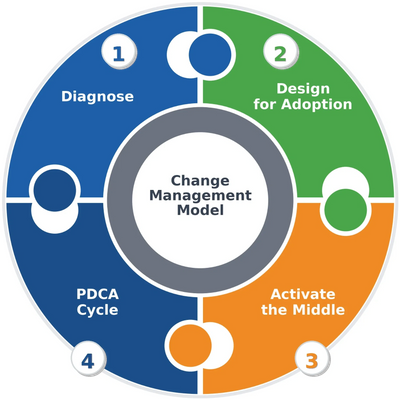
We don’t “force fit” an off-the-shelf solution to your situation. Our approach is purpose-built, blending the right tools and methods based on what your organization is facing and what success requires.
We combine:
- Industry and market analytics to clarify why change is needed and what the future demands
- Organizational diagnostics to pinpoint what must shift—strategy, structure, leadership behavior, culture, systems, and capabilities
- Prosci® change management and PDCA to drive disciplined execution and measurable adoption
- Middle-manager activation to accelerate change adoption—translating strategy into day-to-day execution where change actually happens
The result is a coherent change approach that’s aligned to your context, built for adoption, and designed to stick.
1. Diagnose What Must Change
We begin by diagnosing the organization as a system—examining strategy, leadership behavior, culture, structure, systems, and climate to identify root causes and leverage points. This ensures change efforts are coherent, prioritized, and designed for impact.
2. Design for Adoption
We apply Prosci’s ADKAR® Model and 3-Phase Process to prepare, equip, and support people through change. Sponsorship, people-manager roles, readiness, and reinforcement are intentionally designed so adoption is measurable and sustainable.
3. Activate the Middle (MM-CAM™ - Middle Manager Change Activation Model)
Most transformations break down in execution because middle managers are expected to lead change before they have made sense of it themselves. Our Middle Manager–Centered Change Management Model—grounded in doctoral research—addresses this gap by strengthening four capabilities:
- Context & Containment – Role clarity, decision rights, and expectations
- Sensemaking & Translation – Interpreting strategy and translating it into local meaning
- Change Leadership Enablement – Managing resistance, emotional labor, and performance disruption
- Sustainment Through Agency – Moving managers from change carriers to change owners
Learn about the origins of MM-CAM™ - Middle Manager Change Activation Model
4. Execute and Learn in Real Time
To prevent change from stalling after launch, we use PDCA (Plan–Do–Check–Act) as the execution and learning engine throughout implementation. PDCA is applied through managers, not around them:
- Plan – Translate strategy into clear actions, success metrics, and manager-owned commitments
- Do – Pilot changes, test behaviors, and execute in manageable increments
- Check – Review adoption, performance, and feedback at the team level
- Act – Adjust, reinforce, scale, or course-correct based on real data and lived experience
This disciplined loop enables faster learning, reduces risk, and builds execution muscle across the organization—rather than relying on one-time rollouts or static plans.